
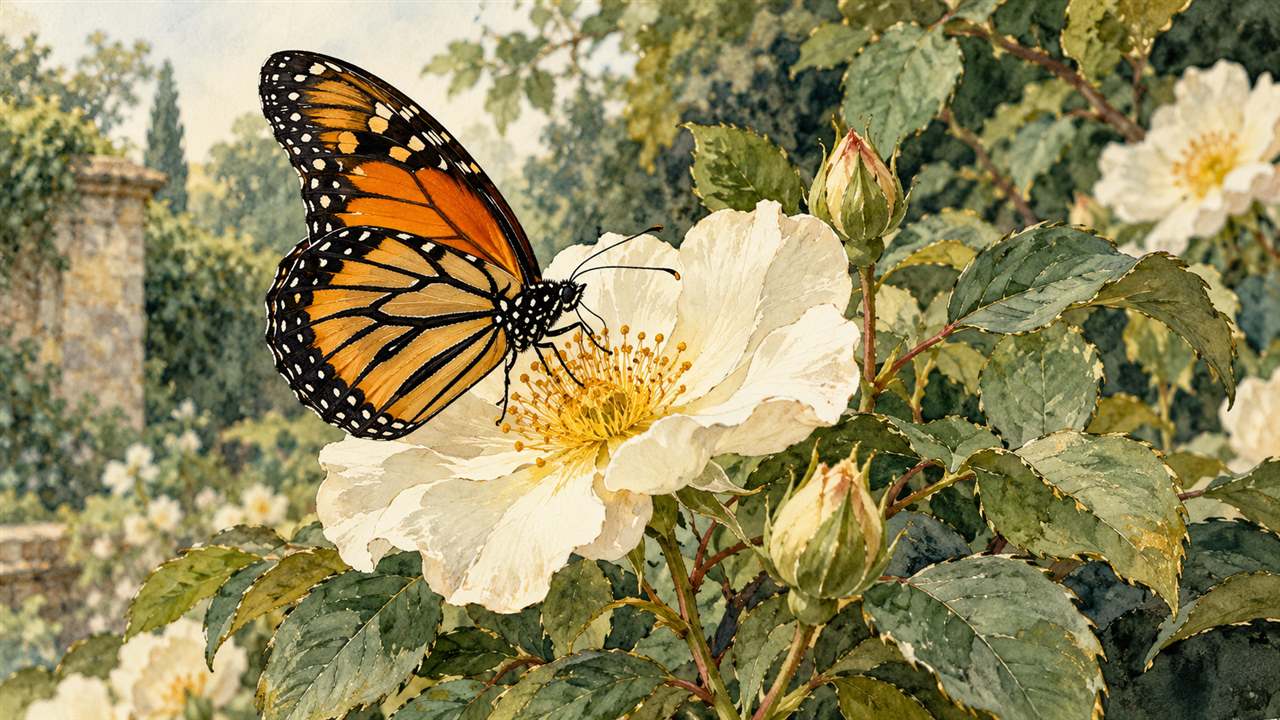
Spiritual meaning of butterflies, in brief: for many people, butterflies symbolize transformation, because a crawling caterpillar becomes a winged adult after a hidden stage inside a chrysalis. Specific cultures have given the butterfly their own meanings. In Chinese art, for example, butterflies have been linked with joy and weddings, and with long life through wordplay, while Diné (Navajo) imagery can use the butterfly to express that beauty has more than one side. A butterfly can also be a personal symbol of change, hope or remembrance. What it cannot do is prove a message, predict an event or guarantee anything. Its meaning comes from the tradition you draw on and the reflection you bring.
This guide looks at where the transformation idea comes from, a few documented cultural meanings, and why you might see butterflies often. It then offers practical tools: a method for reading symbols, journal prompts with worked examples, a respectful observation exercise and thoughts on choosing butterfly art or gifts.
Why butterflies feel spiritual
Few creatures change as completely and as visibly as a butterfly. That is the heart of its appeal as a symbol.
The life cycle in plain terms
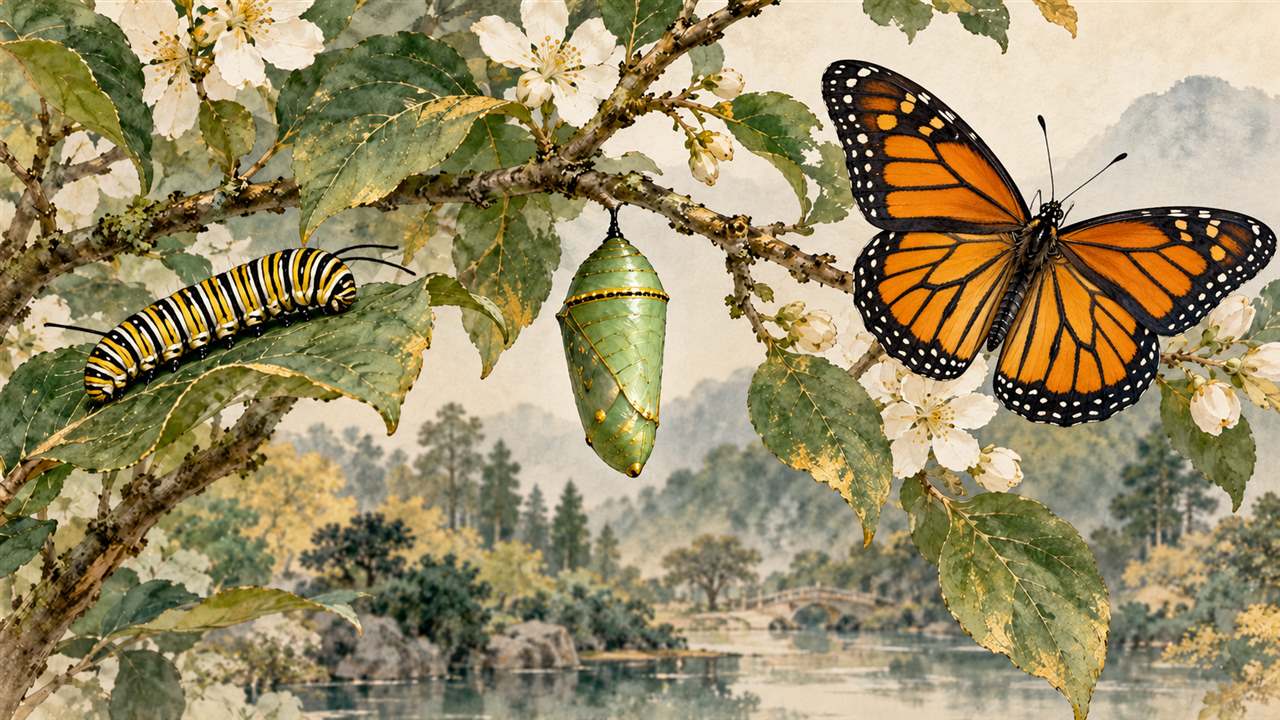
A butterfly begins as an egg, usually laid on a plant the young caterpillar will eat. The caterpillar hatches, feeds and grows, shedding its skin several times. When it is fully grown, it forms a chrysalis, a hard protective casing, and inside it the body is reorganized into an adult form. The adult butterfly eventually emerges, dries its wings and flies off to feed, find a mate and, for females, lay eggs. You’ll often hear that butterflies come out of a cocoon, but the butterfly’s pupal stage is properly called a chrysalis.
From biology to metaphor
It is easy to see why people turn that process into a story about their own lives. There is a long, ordinary stage of growth. There is a period that looks like stillness from the outside but involves deep change within. And there is an emergence into something that seems lighter and freer. People going through a move, a career change, the end of a relationship or a slow recovery of confidence often recognize themselves in that sequence.
The metaphor works best when it is held loosely. Real change in a human life is rarely as neat as a caterpillar becoming a butterfly. People can go back and forth, change more than once, or find that the “chrysalis” stage lasts much longer than they hoped. The butterfly is a picture of possibility, not a schedule.
Documented cultural meanings
Butterflies appear in art and storytelling in many parts of the world, but their meanings are not the same everywhere. Two well-documented examples show how specific they can be.
Butterflies in Chinese art
The Metropolitan Museum of Art holds a seventeenth-century Chinese jade carving of a butterfly. Its record explains that, in China, the butterfly motif was associated with joy, with weddings and with long life, with the long-life association drawing on wordplay in the Chinese language. That kind of association depends on the language and artistic conventions of a particular culture. It would be a mistake to assume it carries across all of Asia or into every Chinese household today.
Butterfly imagery in Diné tradition
The Natural History Museum of Utah’s guide to butterfly symbolism in baskets describes how, for the Diné (Navajo), butterfly imagery can express the dual nature of beauty. Beauty can be admired, but it can also distract, or even be destructive. That is a more complex meaning than the cheerful symbol many people expect, and it belongs to a specific people and their traditions. It should not be presented as the view of all Native American nations, which have many distinct cultures and beliefs.
Why specificity matters
These two examples are a useful corrective to online lists that assign the butterfly one universal meaning. The same insect can stand for joy and long life in one artistic tradition and for the complicated nature of beauty in another. Our guide to lotus flower meaning makes the same point about a very different symbol: context, tradition and setting decide what an image means.
Comparing ways of reading a butterfly
| Lens | What it draws on | Typical meaning | What to keep in mind |
|---|---|---|---|
| Life-cycle metaphor | Caterpillar, chrysalis, adult | Change, growth, emergence | A metaphor, not a timetable for your life |
| Chinese art tradition | Language and artistic conventions | Joy, weddings, long life | Specific to that tradition, not all of Asia |
| Diné imagery | Diné cultural teaching and art | The two-sided nature of beauty | Belongs to one people, not all Native cultures |
| Personal reflection | Your memories and circumstances | Whatever you find meaningful | Meaningful to you, not proof of anything |
Why you might keep seeing butterflies
Many people search for butterfly meanings after noticing them again and again. There are often simple reasons, and knowing them doesn’t have to take the wonder away.
The USDA Forest Service’s page on butterflies as pollinators explains that butterflies visit flowers to drink nectar, and that in doing so they help pollinate plants. So if you are seeing more butterflies, it may be because something is flowering nearby, because you’ve started spending time in a garden or park, or because the season and weather favor them.
Attention plays a part too. Once something becomes meaningful to you, you tend to notice it more. That doesn’t make the moments less real. It simply means that frequent sightings are not, by themselves, evidence of a message.
Both things can be true at once: a butterfly can be visiting the lavender for nectar, and its appearance can still give you a moment of calm or a reminder of someone you love. You don’t have to choose between biology and meaning, as long as you don’t treat the meaning as proof.
Butterflies, remembrance and grief
Many people associate butterflies with loved ones who have died. A butterfly landing near a grave, appearing at a memorial or drifting through the garden on an anniversary can feel deeply significant.
It is natural to feel close to someone in moments like that, and many families build gentle rituals of remembrance around such images. In Vietnamese traditions of honoring ancestors, for instance, families keep the dead present through altars, gatherings and stories, as described in our guide to ancestor worship and Vietnamese traditions. A butterfly can be a personal symbol that sits alongside practices like these.
What this guide won’t do is tell you that a butterfly is a message from the person you’ve lost. This guide treats such an encounter as a personal association rather than evidence of communication. Treating the butterfly as a reminder, a prompt to remember and to feel connected, respects both your experience and the limits of what anyone can honestly say.
Butterflies in dreams
Dreams about butterflies are another common reason people go looking for meaning. Dream dictionaries often offer confident interpretations, but dreams are personal, and no list can tell you what yours means or what will happen next.
A more useful approach is to ask what the butterfly felt like in the dream and what is going on in your waking life. Were you delighted, anxious, chasing it, watching it leave? Is something in your life changing, ending or beginning? The answers belong to you, and they are reflections, not predictions.
A simple method for reading any symbol
The steps below are our own suggestions. They work for butterflies and for most symbols you meet.
1. Notice the facts first
Where were you, what season was it, what was growing nearby, and what was the butterfly doing? Starting with what actually happened keeps reflection grounded.
2. Ask which tradition you’re drawing on
Is the meaning you have in mind from a specific culture, from a family story, from a website, or from your own associations? Each is valid in its place, but they are not interchangeable.
3. Connect it to your own situation
What in your life right now feels like change, waiting or emergence? Let the symbol prompt questions rather than supply answers.
4. Separate meaning from proof
A sighting can be meaningful without being a sign that something will happen. Holding that line protects you from anxiety and from decisions based on chance encounters.
5. Revisit it later
Look back at your notes after a few weeks or months. Did the reflection still feel true, or has your understanding shifted? Meaning often deepens with time, and sometimes a symbol that felt urgent turns out to have been simply a lovely moment. Both outcomes are worth knowing, and neither requires the butterfly to have predicted anything.

Five journal prompts, with worked examples
The examples below are hypothetical, written to show how a prompt might be used. They are not accounts of real people.
1. What stage of change am I in right now?
Example: Someone who recently moved cities writes that they feel like they are still in the chrysalis: not unhappy, but unsettled, with routines not yet formed. Naming that stage helps them be patient instead of judging themselves for not feeling “arrived.”
2. What am I being asked to let go of?
Example: A person leaving a long-held job notices that the caterpillar has to stop being a caterpillar. They list a few habits and assumptions tied to the old role that they no longer need.
3. Where do I feel beauty and difficulty at the same time?
Example: Inspired by the idea that beauty can have more than one side, someone reflects on a new relationship that is exciting but also pulling them away from friends. The prompt helps them see both sides honestly.
4. Who do I want to remember, and how?
Example: After seeing butterflies in the garden their grandmother planted, someone decides to plant one more flower each spring in her memory, a practice that is about remembrance rather than receiving messages.
5. What small thing is quietly growing?
Example: A student notices that their language practice, which felt like it was going nowhere, has actually made conversations easier. Like a caterpillar feeding day after day, progress was happening before it was visible.
A respectful observation exercise
Watching butterflies is one of the simplest ways to connect with them. This short exercise is our own suggestion.
Choose a sunny spot near flowers and sit still for ten or fifteen minutes. Keep your distance, and resist the urge to catch, touch or chase. Butterflies are delicate, and handling can damage them. Notice which flowers they visit, how long they stay, whether they open and close their wings, and how they move between plants. If you’d like a record, take a photo from a respectful distance or sketch what you see.
Afterward, write a few lines: what you noticed, what surprised you and how you felt. Over a season, these notes often become a quiet record of both the garden and your own state of mind. If you want to attract more butterflies, the most helpful step is usually planting a variety of flowering plants and avoiding pesticides where you can.
Choosing butterfly art or gifts thoughtfully
Know the tradition behind the design. A piece inspired by Chinese decorative art, a Diné basket design or a modern illustration each carries different associations. If a design is drawn from a specific culture’s tradition, it’s worth learning a little about it, and buying from makers connected to that tradition where possible.
Match the message to the person. A butterfly gift can say “congratulations on a new beginning,” “thinking of you” or “in memory of someone dear.” A short handwritten note makes the meaning clear without overpromising.
Avoid real specimens unless you know the source. Framed butterflies and wings sold as decor raise questions about how they were collected. Illustrations, prints and jewelry carry the same symbolism without involving a real insect.
Be gentle with grief gifts. For someone who is grieving, a butterfly image can be comforting. Avoid suggesting that their loved one “sent” it. Let them make their own meaning.
Frequently asked questions
What does a butterfly symbolize spiritually?
Most commonly, transformation, drawn from its change from caterpillar to chrysalis to adult. Specific cultures add their own meanings, such as joy and long life in Chinese art or the dual nature of beauty in Diné imagery.
Is seeing a butterfly a sign from a loved one?
Many people feel close to loved ones when they see butterflies, and that feeling is real. But there is no way to know that a butterfly is a message, so it is best held as a personal reminder.
Why do I keep seeing butterflies?
Often because flowers nearby offer nectar, the season suits them, or you are spending more time outdoors. Noticing them more once they matter to you is also common.
What does it mean to dream about butterflies?
Dream meanings are personal. Ask how the butterfly made you feel and what is changing in your life. Dreams are reflections, not predictions.
Do different butterfly colors have different meanings?
Some websites assign meanings to colors, but these vary and are not part of a universal tradition. A color doesn’t foretell events.
Is it okay to touch or catch a butterfly?
It’s best not to. Butterflies are fragile, and handling can harm them. Watch and photograph from a respectful distance instead.
Sources and further reading
The Metropolitan Museum of Art, Butterfly (jade, China, 17th century), collection record.
Natural History Museum of Utah, Butterfly Symbolism.
USDA Forest Service, Butterflies (Celebrating Wildflowers: Pollinators).