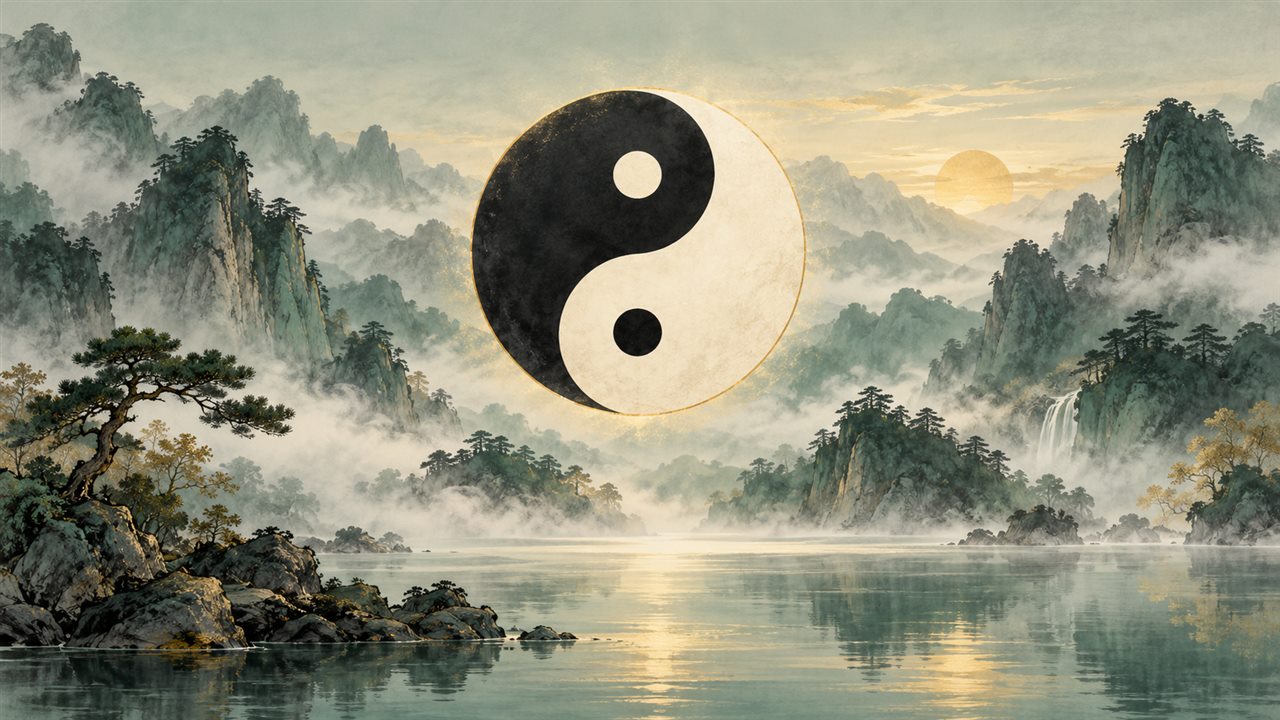
Yin yang meaning in brief: yin and yang are names for two opposite but connected qualities that define each other and keep shifting. Yin leans toward the shaded, cool, quiet, inward and receptive. Yang leans toward the sunlit, warm, active and outward. Neither is better than the other. Each only makes sense next to its partner, and the balance between them is always moving, the way day slides into night. The black-and-white circle most people recognize is a picture of that relationship.
The rest of this guide expands that short answer. It covers where the idea comes from, how to read the symbol, and the misunderstandings that tend to stick to it. It also looks at how Chinese yin yang relates to Vietnamese âm dương, and how you might use the idea as a gentle lens on your home and your day without turning it into a rulebook.
What does yin yang mean?
Yin yang is less a thing than a way of looking at relationships. It does not sort the world into fixed boxes. It asks how two sides of a situation relate to each other. Is one growing while the other fades? Would one even be noticeable without the other?
Picture a room on a winter afternoon. Next to the dim hallway, the sunny room by the window is the brighter, warmer, livelier space, so in that comparison it is the more yang of the two. Now compare the same room with a beach at midday in July, and it reads as cool and shaded, the more yin side. The room did not change. The comparison did. That is why yin and yang work best as labels for a relationship, not permanent tags stuck on objects.
The pairing also carries a sense of mutual need. Rest gives work its rhythm. Silence is what lets a sound be heard. A shadow cannot exist without light. When people talk about yin yang “balance,” the more useful meaning is this ongoing interplay, not a perfect 50/50 split frozen in place.
Where the idea comes from: two sides of one hill
A widely taught explanation, summarized by Columbia University’s Asia for Educators, connects the two words to the landscape. Yang referred to the sunny side of a hill and yin to the shady side. Over time the terms were extended from that concrete image to many paired forces and qualities in early Chinese thinking about how heaven, earth and human life fit together.
The hill image explains a lot on its own. A hill does not have a good side and a bad side. It has a slope in sun and a slope in shade, and as the sun crosses the sky, the shade moves too. By late afternoon, part of the morning’s bright slope sits in shadow, and the shaded slope may catch the last light. It is one hill, held in a relationship that never stops changing.
These ideas developed over a long stretch of early Chinese history, and scholars do not all agree on exactly how or when they took their classic forms. It is more honest to say they grew gradually and were shaped by many thinkers and schools than to pin a single date on them.

How to read the yin yang symbol
The circle of black and white swirls is often called the taijitu, usually translated as the “diagram of the supreme ultimate.” The version most people know is generally thought to be much later than the yin yang ideas it illustrates, and its early history is debated. It helps to see it as a visual summary of the concept, not its original source.
The black half is yin, the white half is yang. Black stands for shade, night and stillness. White stands for light, day and activity.
Each half holds a small dot of the other color. The white dot inside the black and the black dot inside the white suggest that neither side is ever pure. Each carries the seed of its opposite, ready to grow.
The dividing line curves. A straight line would describe two separate territories. The S-shaped curve shows each side swelling where the other thins, which reads as motion: one waxing as the other wanes.
The outer circle holds everything together. Yin and yang are not two things that happen to sit side by side. They are two aspects of one whole.
Read this way, the symbol is closer to a still frame from a moving picture than to a static logo.
Three ideas that make yin yang click
1. It is relative
Something is yin or yang only compared with something else. Evening is yin next to noon but yang next to midnight. A calm person is not “a yin person” in any absolute sense. They are calmer than someone else, in some setting, at some moment.
2. It is complementary and interdependent
In the Internet Encyclopedia of Philosophy, Robin Wang explains that yin and yang depend on each other. Neither can exist or be understood alone, and each contains something of the other. That is a different picture from two rival teams. They behave more like breathing in and breathing out, two phases of a single process.
3. It is always changing
Wang also describes how yin and yang wax and wane. As one grows the other recedes, and at a certain point each can turn into its opposite. The entry frames the goal as an ongoing, dynamic harmonizing of the two, not a fixed, static balance. The seasons make this easy to see. Summer heat peaks and then gives way, and the longest night of winter is also the point where the days start to lengthen again.
Put the three ideas together and “balance” no longer means a perfect midpoint. It means keeping a changing relationship workable and adjusting as conditions shift.
Yin and yang at a glance
| Aspect | Yin tends toward | Yang tends toward |
|---|---|---|
| Light | Shade, dusk, night | Sunlight, noon, day |
| Temperature | Cool | Warm |
| Movement | Stillness, rest | Activity, motion |
| Direction | Inward, downward | Outward, upward |
| Sound | Quiet | Lively |
| Season | Autumn into winter | Spring into summer |
Treat the table as a starting vocabulary. Every row is a comparison, and any item can move to the other column depending on what you set it beside.
What yin yang is not
Not good versus evil
Because the symbol is black and white, it is tempting to read it as light versus darkness in a moral sense. That reading does not fit. Shade is not wicked and sunlight is not virtuous, and a world made of only one would be unlivable. Yin yang describes complementary qualities, not a battle between right and wrong.
Not a fixed personality type
Online quizzes sometimes sort people into “yin types” and “yang types.” As a conversation starter that is harmless, but it works against the core of the idea. People shift with context. Someone can be quiet in a meeting, animated with old friends, energetic in the morning and slow by night. A label that never moves misses the point of a concept built on movement.
Not a gender rulebook
Yin has long been associated with the feminine and yang with the masculine, and that history should not be erased. Columbia’s Asia for Educators notes that in traditional Chinese cosmology the pairing was tied to social hierarchy. Yang was linked to the superior position and yin to the subordinate one in relationships such as ruler and subject or husband and wife, which helped present that order as natural. Knowing this history matters. It does not mean anyone today should treat the old ranking as a guide to how men and women should live. You can study how yin yang was used to support hierarchy while also seeing that the concept’s own logic, which is relative, interdependent and changing, fits poorly with any fixed ranking.
Chinese roots and Vietnamese âm dương
Yin yang took shape in Chinese thought, and most English writing on it draws on Chinese texts and scholarship. Vietnam has its own long relationship with the idea. In Vietnamese the pair is âm dương, the Sino-Vietnamese reading of the same two characters, 陰陽.
What stands out in Vietnamese is how ordinary these words are in daily speech. The lunar calendar that sets the date of Tết is âm lịch, literally the yin calendar. The solar Gregorian calendar is dương lịch, the yang calendar. The world of the living is dương gian, and the realm of the dead is âm phủ. For many Vietnamese speakers, âm dương is not an exotic philosophy. It is part of everyday language about time, family ritual and the bond between the living and their ancestors.
Sharing a concept does not mean sharing every custom built on it. Vietnamese traditions have their own festivals, foods, beliefs and local practices, and the same is true of Korea, Japan and other places where yin yang ideas travelled. Talking about “Asian philosophy” as one uniform thing flattens real differences. The Vietnamese zodiac is a familiar example: it follows the twelve-animal cycle but has the Cat where the Chinese version has the Rabbit. You can explore the full cycle in our guide to Vietnamese zodiac signs.
Yin yang in feng shui
Feng shui, a traditional practice concerned with the relationships between people, places and their surroundings, is where many people first meet yin yang today. It works alongside other ideas such as the five elements, and different schools and practitioners apply it in different ways. If you are new to the practice, start with our overview, What Is Feng Shui? Origin, Meaning and Elements.
In a home, the yin yang lens usually comes down to simple questions. Where is this space bright and active, and where is it quiet and dim? Does that match what the room is for? This is a way of noticing, not a measurement. The examples here do not measure qi or establish a scientifically validated energy score.
Yin yang in everyday life: illustrative reflections
The examples below are our own illustrations of how yin yang can work as a thinking tool. They are not ancient rules, and traditions vary widely. Take what is useful and leave the rest.

A bedroom that never feels restful
Imagine a bedroom that doubles as a laundry station, a gym corner and a late-night work desk, with a bright overhead light and a television facing the bed. Through a yin yang lens, a room meant for rest has filled up with yang activity. The change does not have to be dramatic. You could move the exercise gear out, use a lamp in place of the ceiling light in the evening, or clear the bedside table. The aim is not a dark, silent cave but a room whose quieter qualities suit its purpose. If sleep is a real problem, though, rearranging a room is no substitute for talking to a doctor.
A home office that feels flat
The opposite can happen too. A desk tucked into a dim corner, facing a wall, with heavy curtains always closed, can feel too sleepy for focused work. Opening the curtains, adding a plant, or turning the desk so you can see part of the room brings in a little more yang without turning the space into a showroom.
A living room that has to do everything
Many living rooms host morning coffee, children’s play, video calls and quiet reading. Instead of chasing one fixed balance, think in shifts: brighter light and open space during the active hours, softer light and fewer distractions in the evening. The room’s balance changes through the day, which is exactly what the symbol suggests.
The rhythm of a day
A day already has a yin yang shape: waking, rising activity, a midday peak, then a slow descent into evening and night. Some people find it useful to notice where their own days are lopsided. A week of nonstop meetings with no quiet time leans heavily one way. A long stretch of isolation and inactivity can tip the other way. The point is not a perfect schedule but noticing when the swing has gone too far and nudging it back.
Work, conversation and relationships
In a conversation, speaking and listening behave something like yang and yin. A meeting where everyone talks and nobody listens rarely goes well, and neither does one where everyone waits in silence. A team might pair someone who pushes ideas forward with someone who slows down to check the details, and the combination often works better than either alone. These are loose analogies, not prescriptions, and they apply to anyone, regardless of gender or personality.
The bigger picture: change and cycles in Chinese thought
Yin yang sits inside a wider way of thinking about the world. The Stanford Encyclopedia of Philosophy entry on Chinese metaphysics describes a tradition that tends to see reality as interconnected and constantly changing. It pays attention to processes and recurring cycles more than to fixed, unchanging substances. The same entry stresses that there is no single “Chinese view.” Ideas varied across schools, texts and periods, and thinkers often disagreed.
That is a useful caution for anyone writing or reading about yin yang. Short explainers, this one included, simplify a rich and debated tradition. If the idea has caught your curiosity, the sources below are good places to go deeper.
Frequently asked questions
Is yin good and yang bad, or the other way around?
Neither. Yin and yang are complementary qualities, not moral categories. Shade and sunlight, rest and activity are both necessary, and too much of either becomes a problem.
Which side of the yin yang symbol is black and which is white?
The black side represents yin and the white side represents yang. The small dot of the opposite color inside each half shows that each side contains the seed of the other.
What do the two small dots mean?
They suggest that nothing is purely yin or purely yang. The deepest night already holds the beginning of day, and the brightest noon already holds the start of evening.
Is yin female and yang male?
Historically, yin was associated with the feminine and yang with the masculine, and these associations were used to support social hierarchies. That history is real, but it does not set rules for how anyone should live today, and no individual is simply one or the other.
Is Vietnamese âm dương the same as Chinese yin yang?
The concept and the characters are shared, and âm dương is the Vietnamese reading. Vietnam has developed its own language, customs and practices around the idea, so it is best understood as related but not identical.
Can yin yang predict my future or diagnose health problems?
No. In this article, yin yang is a way of understanding relationships and change. It cannot guarantee luck, predict events or replace medical advice. For health concerns, see a qualified professional.
Sources and further reading
Robin Wang, “Yinyang (Yin-yang)”, Internet Encyclopedia of Philosophy.
Columbia University, Asia for Educators, background reading on Chinese cosmology.
“Metaphysics in Chinese Philosophy”, Stanford Encyclopedia of Philosophy.