Ancestor worship in brief: ancestor worship, often called ancestor veneration, is the practice of honoring family members who have died through remembrance, offerings and ritual. In Vietnamese homes that observe it, this usually centers on a family altar, incense, fruit, flowers and food, and on gatherings such as the death anniversary (giỗ) and Tết. For many families it is less about asking for things than about gratitude, continuity, and keeping loved ones part of family life. Beliefs and practices vary widely between families, regions and religions.
This guide explains what the terms mean, how veneration differs from worship, and what common rituals look like in Vietnam. It also covers how visitors and families living abroad can take part respectfully. It describes traditions. It does not prescribe one correct way to observe them.
What is ancestor worship?
At its simplest, ancestor worship says that the people who came before you still matter. A grandmother’s photo on a shelf, a bowl of her favorite fruit set out on the anniversary of her death, a family meal where her stories get retold: these are all forms of the same wish to stay connected across generations.
What turns that wish into a tradition is shared practice. Families keep a dedicated place for remembrance, mark particular dates, prepare particular foods and follow habits handed down by parents and grandparents. Over time those habits carry values with them. They include gratitude toward the people who raised you, responsibility toward the family line, and the sense that a household includes more people than those at today’s dinner table.
The word “worship” can lead English readers to imagine ancestors being treated as gods. For many families who keep the practice, the relationship feels closer to ongoing respect and care. That is why many writers prefer the phrase “ancestor veneration.”
Ancestor veneration vs. ancestor worship
Both terms are in common use, often interchangeably, in books, travel guides and family conversations. The difference is mostly one of emphasis.
“Ancestor worship” is a widely used English phrase. It captures the ritual side: offerings, prayers, incense and ceremonies at set times. Some readers hear it as implying that ancestors are divine beings, which does not match how many practitioners describe their own beliefs.
“Ancestor veneration” stresses honor and respect, not the worship of a deity. It can help families make clear that remembering a grandfather is not the same as praying to a god. That distinction can matter to people whose faith reserves worship for God alone but who still want to honor their parents and grandparents.
In Vietnamese, the practice is commonly called thờ cúng tổ tiên, which brings together honoring ancestors and making offerings to them. Neither English phrase captures it perfectly. This article uses both terms, on the view that what people actually do matters more than the label.
Deep roots, many forms
Honoring ancestors is not unique to any one country, and in East Asia it has a very long history. A Smithsonian educator resource, The Art and Archaeology of Ancient China, notes that Chinese ancestor worship can be traced back as far as the Shang dynasty. It also notes that the practice still varies from one community to another today.
Vietnamese ancestor veneration shares some ideas with Chinese traditions, but it is not a copy of them. It grew up alongside Vietnamese family life, village customs, Buddhism and local beliefs. It also looks different in a Hanoi apartment, a Mekong Delta farmhouse and a family home in California. This article focuses on how the practice shows up in ordinary life, not on a long history.
What ancestor rituals usually involve
Many familiar practices are simple. Pew Research Center’s 2024 report on ancestor veneration, funerals and afterlife beliefs looked at practices such as burning incense, offering flowers, food or drinks, and caring for family graves. It found that these practices are not confined to people of one religion: people with different religious identities, and people with none, take part. How common each practice is also varies between the societies Pew surveyed.
For many families, ancestor rituals are a matter of family custom more than formal religious membership. The table below summarizes common elements. These are typical forms, not a checklist.
| Element | Typical form | What it often expresses |
|---|---|---|
| Incense | Lit at a home altar, temple or grave | Respect and a moment of focused attention |
| Fruit and flowers | Fresh, seasonal, neatly arranged | Care, beauty and generosity |
| Food and drink | Cooked dishes, rice, tea or wine | Hospitality and sharing a family meal |
| Photos and names | Portraits or written records of relatives | Memory and family identity |
| Grave care | Cleaning, tidying, leaving flowers | Ongoing responsibility toward the dead |
Ancestor worship in Vietnamese traditions
Many Vietnamese families keep some form of ancestor veneration, though by no means all of them do. Where it is practiced, a few elements tend to recur.
The family altar
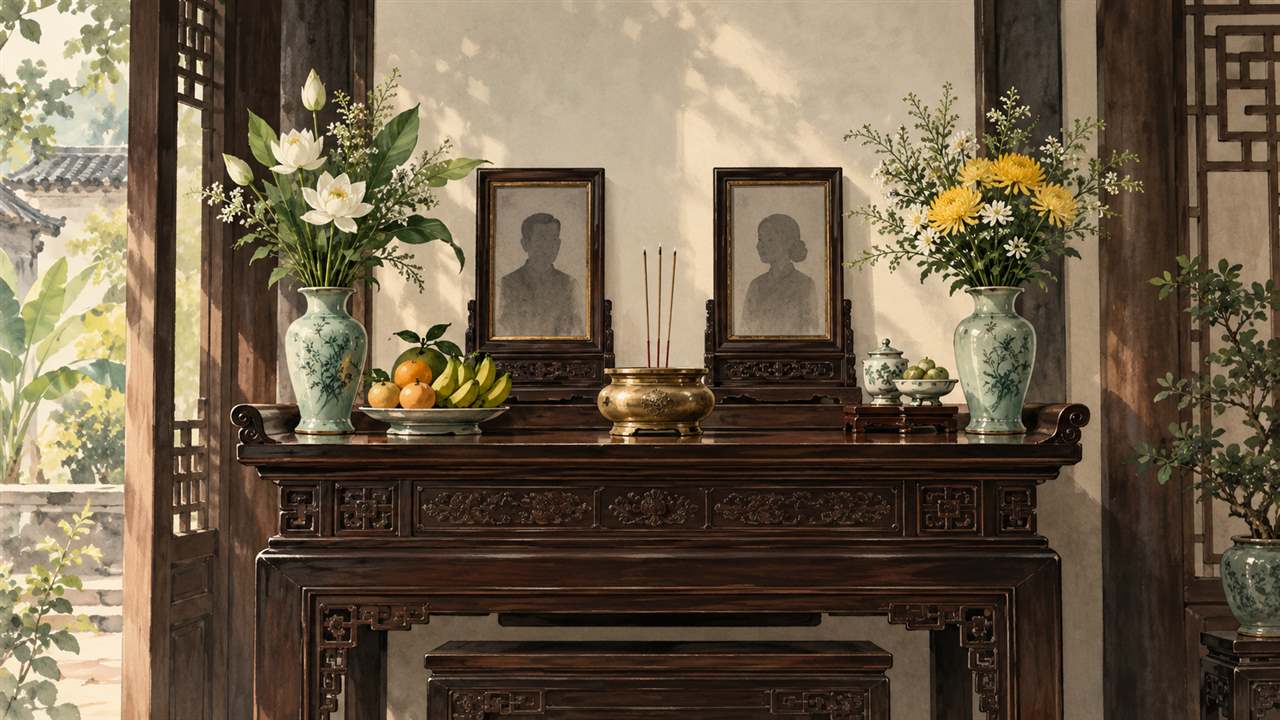
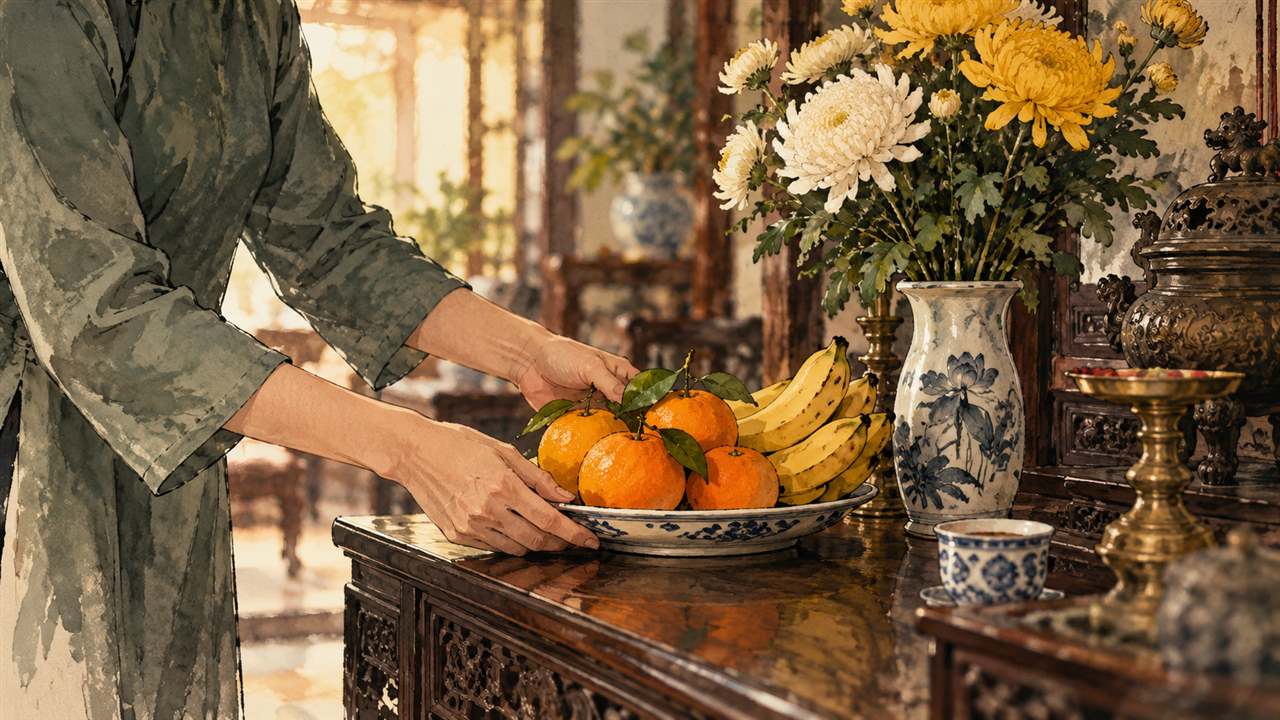
The altar (bàn thờ) usually sits in a clean, respected part of the home, often raised above eye level. It might hold photos of deceased relatives, an incense bowl, candles or small lamps, vases of flowers, a plate of fruit and little cups for tea or water. Some families keep carved wooden altars passed down through generations. Others use a simple shelf in a city apartment. Where and how an altar is set up depends on the home, regional custom, religion and whose advice the family follows. There is no single correct direction or layout that applies to everyone.
Many households light incense and refresh offerings on the first and fifteenth days of the lunar month (mùng một and rằm). They may also do so at family milestones such as a wedding, a new baby or a child leaving to study abroad, when the family may share the news with the ancestors. It is a way of including them in the life of the household.
Giỗ: the death anniversary
For many families, the most important date is giỗ, the anniversary of a relative’s death, usually counted by the lunar calendar. A Vietnam National Authority of Tourism overview of ancestor customs describes it as an occasion when descendants and relatives gather and prepare a commemorative feast. Many families hold the belief that ancestors continue to watch over and bless their descendants, and the gathering expresses gratitude within that relationship.
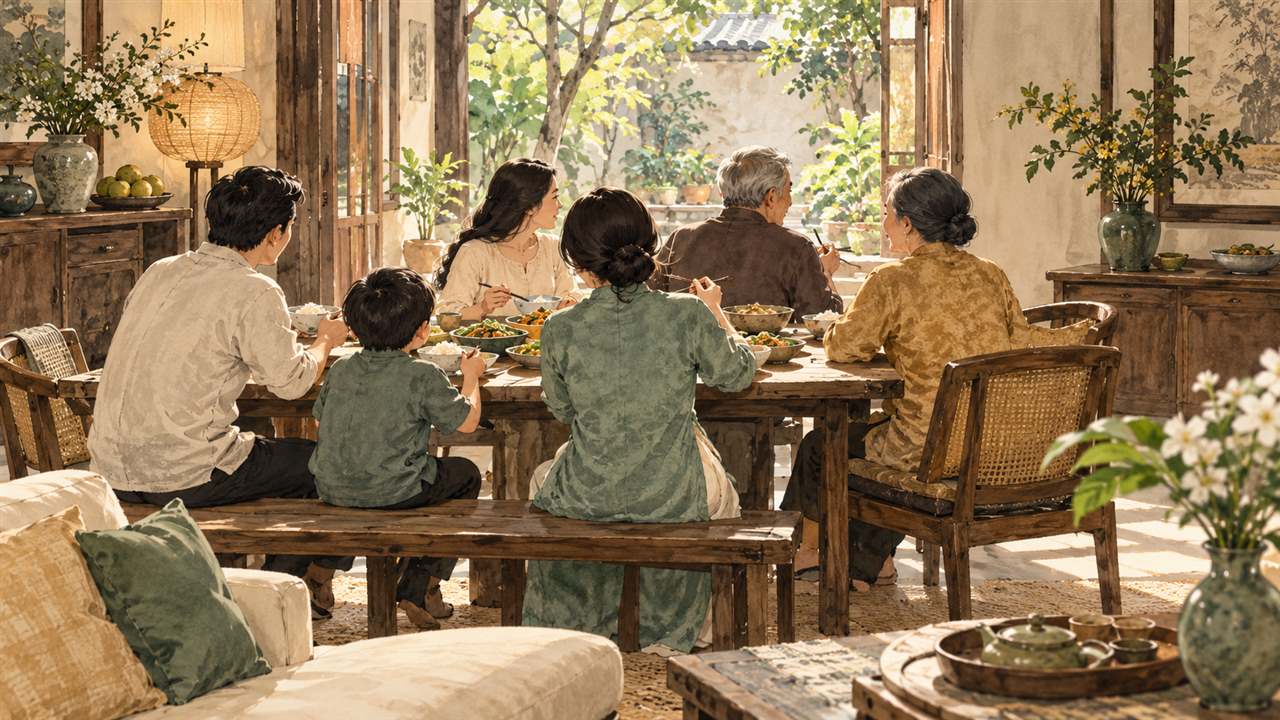
A giỗ often begins with the family offering a meal at the altar: dishes the person enjoyed, rice, fruit, and tea or wine. An older relative may light incense and speak quietly to the person being remembered. Once the offering is complete, the food is brought down and shared. The meal is the heart of the day. Cousins catch up, children hear about a great-grandparent they never met, and stories that might otherwise fade get told again.
Giỗ also has practical weight. It is often the day an extended family reconnects, makes plans or decides who will host next year. For relatives scattered across cities or countries, it can be one of the few fixed points in the calendar.
Tết and the ancestors
During Tết, the Lunar New Year, many families clean and decorate the altar, add flowers and special dishes, and welcome their ancestors into the celebration. Our guide to Tết covers the wider holiday, its food and its customs. Here it is enough to say that ancestors are treated as part of the family as it greets the new year.
Grave visits and the two worlds
Some families also visit and tidy relatives’ graves, especially around Tết or during the Thanh Minh period in spring. In Vietnamese, the world of the living and the realm of the dead are sometimes described with the paired words dương and âm, the same terms behind yin and yang. Ancestor rituals can be seen as one way families keep up a relationship between those two worlds, so that death is not treated as a complete break.
Many families, many beliefs
It would be wrong to say that every Vietnamese person practices ancestor worship, or that everyone who does means the same thing by it. Some families see it as a religious duty connected to Buddhism or folk belief. Others treat it mainly as a cultural and moral tradition, a way to teach children gratitude. Some keep a full altar, others only a photo and a candle. Many Christian families honor deceased relatives in ways shaped by their own faith, and some choose not to burn incense or make food offerings. Families also change over time. A younger couple might keep a smaller altar than their grandparents did, or blend customs after marrying across religions or cultures.
Each of these approaches can carry real love and respect. Whether you are writing about the practice or meeting it for the first time, the fairest assumption is that you do not know a family’s beliefs until they tell you.
Visiting a home during an ancestor ritual
The points below are our own suggestions for visitors. They are based on general courtesy, not fixed rules, and your host’s guidance always comes first.
Ask before you act. If you are invited to a giỗ or a Tết visit, it is perfectly fine to ask whether you should light incense or simply observe. Many hosts appreciate being asked.
Dress neatly and modestly. Think of it as a family occasion with a quiet ceremony at its center. Clean, simple clothes are a safe choice.
Leave the altar to the family. Avoid touching photos, moving offerings or taking fruit from the altar unless you are invited to. Food is usually shared only after the offering is finished and the family brings it down.
Ask before taking photos. An altar can feel very personal, especially after a recent death.
Bring something small if it suits the occasion. Fruit, flowers, tea or a box of sweets are common, thoughtful gifts. If you are unsure, ask a mutual friend what the family usually welcomes.
Follow the mood of the room. A giỗ for someone who died decades ago can be lively and full of laughter. One for a recent loss may be quiet and heavy. Take your cue from the family.
Respectful questions you can ask your host
Gentle curiosity is usually welcome. Questions like these can start a warm conversation without putting anyone on the spot:
“Would you like me to light incense, or is it better if I just watch?”
“Who is being remembered today? I’d love to hear a little about them.”
“Is there anything I should avoid doing near the altar?”
“Are these dishes ones your family always makes for this day?”
It is kinder to avoid questions that frame the ritual as superstition or ask your host to justify what they believe.
Remembering ancestors far from home
For Vietnamese families living abroad, ancestor veneration often adapts to new homes, schedules and rules. The scenarios below are illustrations, not accounts of real families.
A bookshelf altar. A student in Melbourne keeps a framed photo of her grandfather on a bookshelf, with a small vase and a dish for fruit. On his giỗ she video-calls her parents in Đà Nẵng during the family gathering, then cooks one of his favorite dishes to share with her flatmates.
An apartment with fire rules. A couple whose building bans open flames uses an electric candle and fresh flowers at home. They light incense only when they visit a temple or a relative’s house.
A mixed-heritage family. A Vietnamese-Canadian family marks a grandmother’s anniversary with a home-cooked meal, a quiet moment at her photo, and stories told in two languages, so that children on both sides know who she was.
These examples show how the core idea of keeping loved ones present through remembrance and care travels and changes shape.
Frequently asked questions
What does ancestor veneration mean?
It means honoring family members who have died through remembrance, offerings and ritual. The word “veneration” stresses respect and gratitude more than worship of a divine being.
Is ancestor worship a religion?
It does not belong to one religion or have one meaning for everyone. It can form part of religious life, coexist with Buddhist or other beliefs, or be understood primarily as a family and cultural tradition.
What are common examples of ancestor worship and offerings?
Typical examples include lighting incense at a home altar, offering fruit, flowers, tea or a cooked meal, keeping photos of deceased relatives, holding a death-anniversary gathering, and cleaning family graves.
Do all Vietnamese families practice ancestor worship?
No. Many do, but practices and beliefs vary widely, and some families, including some religious families, honor their relatives in other ways or not through ritual at all.
How many incense sticks should I light?
There is no universal number. Customs differ by family, region and occasion. If you are a guest, simply ask your host what they prefer, or watch and follow their lead.
Can I attend a giỗ or Tết gathering if I’m not Vietnamese or not religious?
Usually, yes, if you are invited. Hosts generally welcome respectful guests. You can choose to observe without taking part in the ritual, and it is fine to say so politely.
Sources and further reading
Pew Research Center, “Ancestor veneration, funerals and afterlife beliefs” (2024).
Vietnam National Authority of Tourism, article on Vietnamese death anniversary customs.
Smithsonian Institution, The Art and Archaeology of Ancient China: A Teacher’s Guide (PDF).