
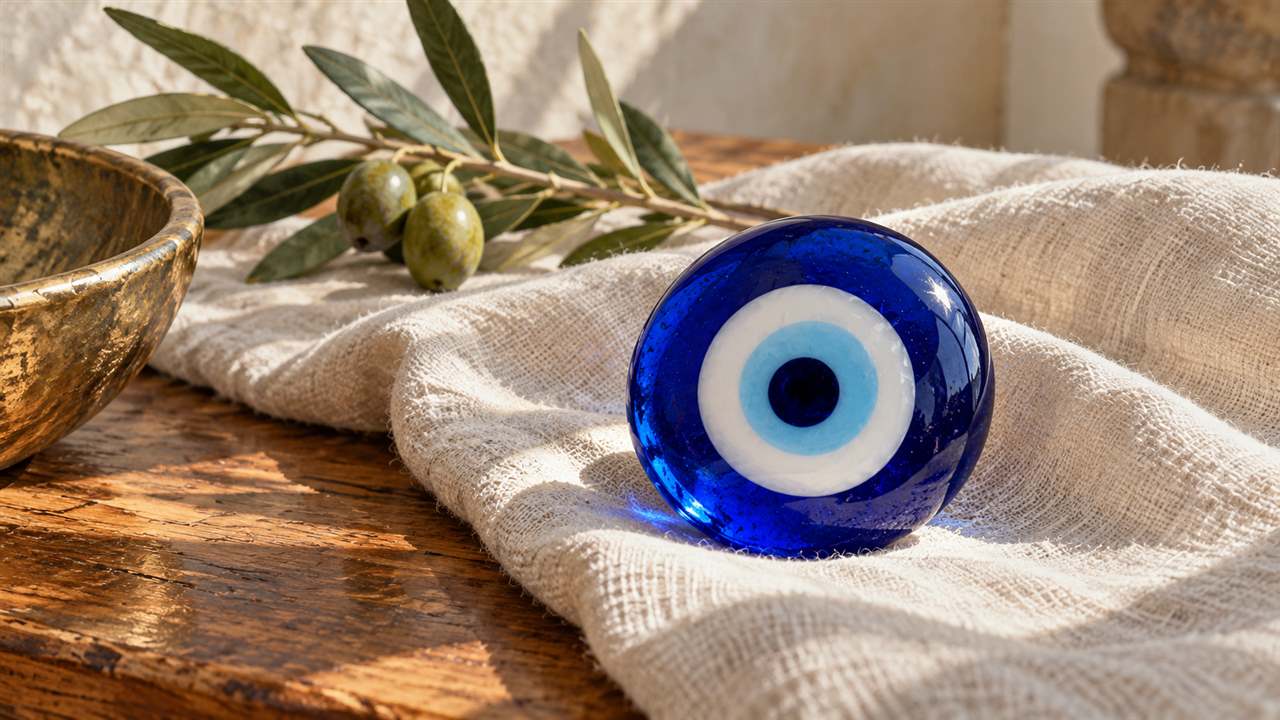
Evil eye meaning, in brief: the “evil eye” is a belief, found in many cultures, that an envious or admiring look can bring harm or bad luck to a person or something they value. The blue eye charm many people wear, often called a nazar, is not the evil eye itself. It is a protective symbol meant to turn that feared look away. So the charm is not evil. It stands for the hope of protection against envy. Beliefs, objects and customs vary widely from place to place and family to family, and no charm can guarantee anything.
This guide explains the difference between the belief and the charm, looks at a few documented objects from museum collections, compares the eye bead with the hand motif often seen beside it, and then turns to practical questions: how to read an object label, how to buy or gift an evil eye piece with care, and what a broken charm does and doesn’t mean.
What does the evil eye mean?
The phrase “evil eye” points to two different things, and much confusion comes from mixing them up.
The belief: a harmful look
At its core, the evil eye is an idea about envy. In many traditions, people have worried that a jealous, greedy or even overly admiring glance could cause misfortune. A new house, a good harvest or a successful business might be treated as especially exposed in such stories. In some versions the look is deliberate. In others, a person might cast it without meaning to, simply by staring too long or praising too much.
Underneath the folklore sits something very human: the uneasy feeling that good fortune attracts resentment, and that showing off invites trouble.
The charm: a protective eye
The familiar blue-and-white eye, worn as a pendant, or displayed in a home, is meant to answer that fear. One common way of understanding it is that the charm “looks back,” catching or deflecting a harmful gaze before it lands. Whatever the explanation in a particular family, the intention is protective.
That is why calling a nazar “an evil eye” can be misleading. In everyday English the charm has borrowed the name of the thing it is meant to guard against. The object itself is meant to protect, not to harm.
Where the belief appears
Beliefs about harmful looks and protective objects have been recorded across the Mediterranean, West Asia, parts of North Africa and Europe, and in communities that have carried those traditions elsewhere. It would be a mistake to treat this as one single belief with one origin and one invention date. Different peoples, languages and religions have held their own versions, and those versions have changed over time.
It would also be a mistake to assume that everyone in any of these places holds the belief. Some families take it seriously, some keep the charm as a cultural habit or a gift from a grandparent, and many people don’t think about it at all. Religious traditions within the same region may view the practice quite differently, and individual believers within one faith may disagree with each other. A charm on a keyring tells you very little about what its owner actually believes.
What museum objects show
Museum records are useful because they tie a belief to a specific object, place and time, without claiming that everyone everywhere shared it. Four examples show how varied protective objects can be.
Ancient amber and the fear of envy
A scholarly catalogue from the Getty, on ancient carved amber, discusses how amber objects could serve both as ornaments and as amulets. It places that protective use in the context of ancient worries about envy. The catalogue is a reminder that the line between jewelry and protection has often been blurred: a beautiful object could also carry a hope of safety. The historical beliefs it describes are part of the past, not practical advice for today.
A glass eye charm from the First World War
The Science Museum Group holds a glass amulet recorded as a nazar worn by a soldier serving in Palestine during the First World War.
An agate eye carried by Devon fishermen
The same collection includes an agate amulet from Devon, in England, described as an eye amulet carried by fishermen and dated in the record to 1901–1911. It shows that protective eye objects were not limited to the eastern Mediterranean, and that working people facing the risks of the sea had their own versions.
A hand clutching rue from Naples
A third Science Museum Group object is a small metal hand clutching a sprig of rue from Naples, dated to 1800–1850. It is a good example of a protective object that is not an eye at all. A hand and a plant could carry the same protective hope through entirely different imagery.
Taken together, these records show variety: different materials, different shapes, different places, different centuries. They don’t prove that any charm worked, only that people in many settings turned to small objects when they felt exposed.
Nazar and hamsa: related, not interchangeable
Two symbols often appear side by side in shops and online, and they are frequently treated as one. They are not.
The nazar eye bead
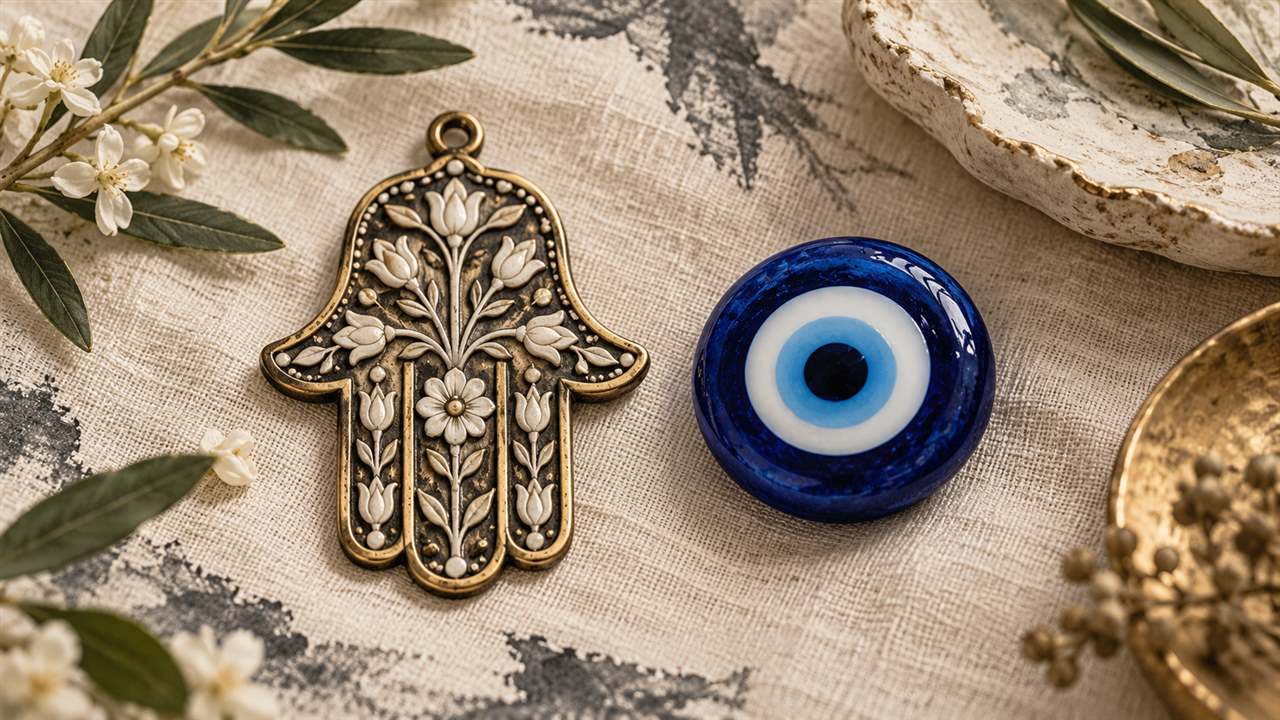
The nazar is the eye charm most people picture: concentric rings, usually with a deep blue outer ring, then white, lighter blue and a dark center. It is especially associated with the eastern Mediterranean and West Asia. It is commonly made of glass, though today it appears in ceramic, enamel, resin, metal and printed designs.
The hamsa hand motif
The hamsa or khamsa is a hand-shaped amulet, sometimes shown with an eye in the palm. It appears in parts of North Africa and the Middle East and is used by people from more than one religious and cultural background, each of whom may understand it in their own way. Because those understandings differ, it is wise not to assign the hand a single fixed meaning.
Why the difference matters
When a jewelry piece combines a hand and an eye, it is blending two symbols, each with its own history and associations. That can be a lovely design choice, but it helps to know what you are looking at. Calling every hand “an evil eye” or every eye “a hamsa” erases real differences between traditions.
Comparing protective symbols
| Symbol | Typical form | Often associated with | Common confusion |
|---|---|---|---|
| Evil eye (belief) | Not an object; an idea about a harmful look | Envy, excessive praise, misfortune | Mixed up with the charm meant to avert it |
| Nazar | Blue and white eye bead, often glass | Turning away a harmful gaze | Called “an evil eye” as if it were harmful |
| Hamsa | Open hand, sometimes with an eye | Protection, with meanings that vary by community | Treated as identical to the nazar |
| Other amulets | Amber, agate, hands, plants and more | Local protective traditions | Overlooked because they don’t look like an eye |
As with any symbol, context decides meaning. Our guide to lotus flower meaning makes the same point about a very different image: the same motif can carry different ideas depending on tradition, setting and use.
Common misunderstandings
“The evil eye charm is evil”
It is meant as the opposite. The charm is a protective symbol.
“Each color has a fixed meaning”
Online charts often assign a specific power to red, green, pink, yellow and other colored eyes. Such interpretations vary from seller to seller. A useful chart should identify the tradition and source behind its claims. Blue is familiar in the nazar design, but this guide does not assign a universal power to each color.
“A charm guarantees protection”
No object can promise safety, luck, health or success. People wear them for faith, family habit, comfort or style, none of which requires treating the charm as a guarantee.
“Bad luck means someone gave you the evil eye”
A run of setbacks, an illness or a difficult day is not evidence of a curse. Treating ordinary misfortune as someone else’s envy can lead to suspicion of friends, neighbors or relatives, which tends to cause more harm than the belief ever addressed. If you are unwell, see a doctor. If a situation feels wrong, look for practical causes first.
What if your evil eye charm breaks?
Some people have heard that a cracked nazar means it “absorbed” a harmful look. That is a belief some families hold, and it is fine to respect it as part of their tradition. But breakage does not prove anything supernatural happened.
Glass and ceramic are fragile. A bead can crack from being knocked against a table, dropped, squeezed in a bag, exposed to sudden temperature change or simply aging along a small flaw from manufacture. Cords fray, jump rings open, and glue lets go. In other words, charms break for the same reasons other small objects do.
If yours breaks, collect sharp pieces carefully, especially around children and pets. Then decide what feels right to you: repair it, replace it, keep the pieces as a memento, or let it go. If it came from a family member, you might ask what their custom is. The choice is about meaning and respect, not about measuring harm.
How to read an evil eye object label
Whether you are in a museum, an antiques shop or browsing online, a little attention to the description tells you a lot. These suggestions are our own.
Check the place and date. A label that names a specific town and period is more informative than a vague “ancient protective symbol.” Notice whether the date is precise, a range, or missing.
Notice the material. Glass, agate, amber, metal and plastic each tell you something about how and when an object was likely made.
Look for who used it. The best records mention a person or group: a soldier, a fisherman, a family. That human detail is what turns an object into a story.
Be wary of sweeping claims. Phrases like “used by all ancient peoples” or “guaranteed to protect” are signals of marketing, not history.
Two illustrative museum visits
These are imagined scenarios to show the method, not descriptions of specific displays.
Imagine a case with a small blue glass bead beside a typed label. At first it looks like the charms sold in every souvenir shop. Then you read that it was carried by a traveler a century ago, and you notice the worn surface and the old cord. The object suddenly feels personal: someone held this for reassurance.
Now imagine a nearby case holding a tiny metal hand gripping a sprig of a plant. It doesn’t look like an “evil eye” at all, and you might walk past it. The label explains it was a protective charm. You realize that protection from envy has taken far more shapes than the blue eye alone.
Buying or gifting an evil eye piece
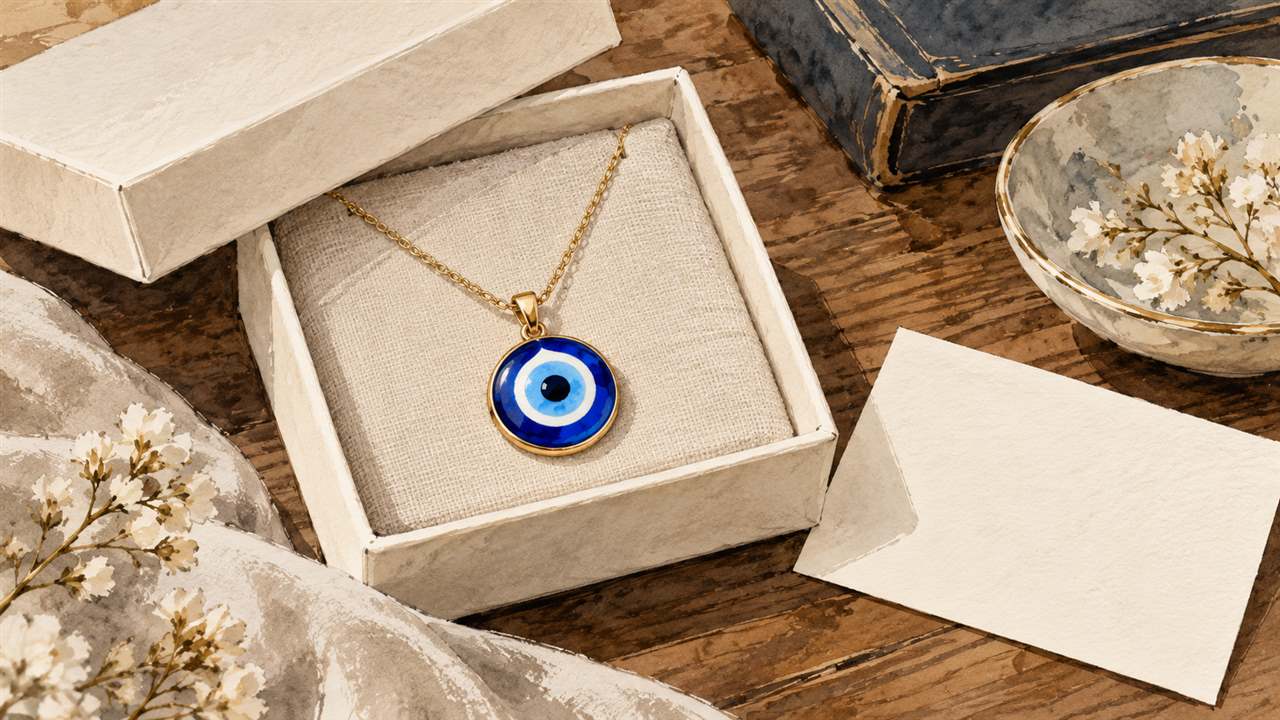
Know what you are giving. If you choose a nazar, a hamsa or a piece combining both, it helps to know which is which, so you can explain it if asked.
Think about the person receiving it. For some people an eye charm is a warm cultural reminder. For others it may clash with their religious views or feel uncomfortable. If you’re unsure, a simple question, or choosing a different gift, is kinder than assuming.
Respect family meanings. Many families have their own customs, such as displaying a charm by the door or passing one down as a keepsake. If you are a guest in that home, follow their lead rather than offering your own interpretation.
Be honest about the message. A card that says “a little something for luck and good wishes” is warmer and more accurate than one promising protection.
Choose for the intended use. A wall decoration, a keyring and a pendant need different fittings. Ask the maker about the materials and choose a piece the recipient can use comfortably.
Caring for an evil eye charm
Care depends on the material, finish and construction. Follow the maker’s instructions for cleaning and storage, especially for plated metals, painted surfaces or glued fittings. Avoid assuming that every blue bead is solid glass. Check cords and clasps now and then so a favorite piece doesn’t fall off unnoticed. There is no special ritual needed to keep it “working,” and this guide doesn’t offer cleansing instructions.
Personal meaning versus claims
It is entirely possible to love an evil eye charm without believing it controls anything. Some people wear one because their grandmother did. Some like the color and design. Some find it a small, steadying reminder to be modest about good news, or to be generous instead of envious. Those personal meanings are real and worth having.
What is worth resisting are claims that turn the charm into a product promise, or the belief into a reason to fear people around you. Many traditions, including the balance of opposites described in our guide to yin and yang, are richer when treated as ways of reflecting on life rather than as guarantees.
Frequently asked questions
What does the evil eye symbol mean?
The eye charm, often called a nazar, is a protective symbol meant to turn away an envious or harmful look. The “evil eye” itself refers to the feared look, not the charm.
Is it bad luck to wear an evil eye?
No. The charm is intended as protective. Whether to wear one is a personal choice, and it can’t guarantee good or bad luck either way.
Are the hamsa and the evil eye the same?
No. The nazar is an eye bead. The hamsa is an open-hand motif that sometimes includes an eye. They are related in use but distinct symbols with their own histories.
What does it mean when an evil eye bracelet breaks?
Physically, it means the material or cord gave way. Some families see breakage as meaningful, but it doesn’t prove a supernatural attack.
What do different evil eye colors mean?
Color meanings vary by seller and modern source. Blue is familiar in nazar designs, but this guide does not assign a universal color code.
Is it okay to give an evil eye as a gift?
Usually, yes, if you know the recipient. Consider their cultural and religious views, and frame it as good wishes, not a promise of protection.
Sources and further reading
Science Museum Group Collection, Glass amulet.
Science Museum Group Collection, Amulet to ward against the evil eye.
Science Museum Group Collection, Metal hand clutching a sprig of rue.
J. Paul Getty Museum, Ancient Carved Ambers in the J. Paul Getty Museum (online catalogue).