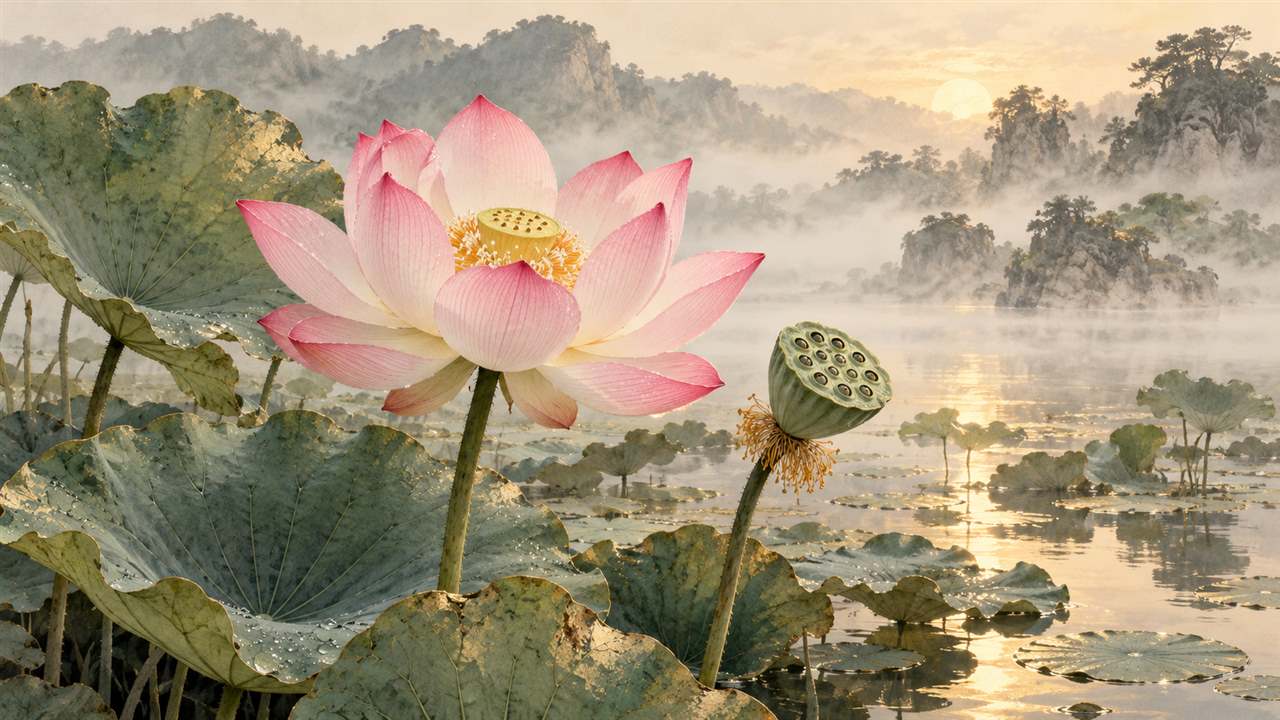
Lotus flower meaning, in brief: the lotus is a flower that rises from muddy water and opens clean above the surface, so in Buddhist and Hindu traditions it is widely associated with purity, spiritual awakening and transformation. Buddhist and Hindu art often show sacred figures seated on lotus thrones or holding the flower. Ancient Egypt had its own “lotus” symbolism, but the Egyptian flower was actually a water lily, linked with daily rebirth and the renewal of the sun. The meaning of any particular lotus depends on which tradition, which plant and which setting you are looking at.
This guide walks through those traditions one at a time, explains why the botanical difference matters, and then turns to practical questions: how to read a lotus in a work of art, which common assumptions to drop, and how to choose lotus imagery thoughtfully for your own home or jewelry box.
What does the lotus flower mean?
Most people meet the lotus as a feeling before they meet it as a symbol. A pink bloom standing on a straight stem above a dark pond is striking in a way that needs no explanation. The roots sit in mud, the stem passes through murky water, and the petals open into air and sunlight looking untouched by any of it. It is easy to see why so many people, in so many places, have looked at that flower and seen an image of growth that does not deny where it started.
That shared image is the closest thing the lotus has to a common meaning. Rising out of difficulty, staying clear while surrounded by mess, opening toward light: those ideas appear again and again. But it would be a mistake to stop there. The same flower, or a flower that looks similar, has carried different ideas in Buddhist teaching, Hindu art, ancient Egyptian religion and Daoist imagery. Each tradition built its own layers on top of what people saw in the pond.
A useful interpretation starts with two details: which flower is depicted and where the image was made or used.
First, which flower? Lotus versus water lily
The word “lotus” covers more than one plant in everyday English, and that causes real confusion.
The sacred lotus
The plant at the center of Hindu and Buddhist symbolism is the Indian or sacred lotus, Nelumbo nucifera. The University of Vermont’s plant biology department, in its overview of symbolism and plants, identifies this species and connects it with Hindu and Buddhist symbolism. If you have seen a lotus with large round leaves and flowers held well above the water, often with a distinctive seed head in the center, it was probably this plant.
The Egyptian “lotus”
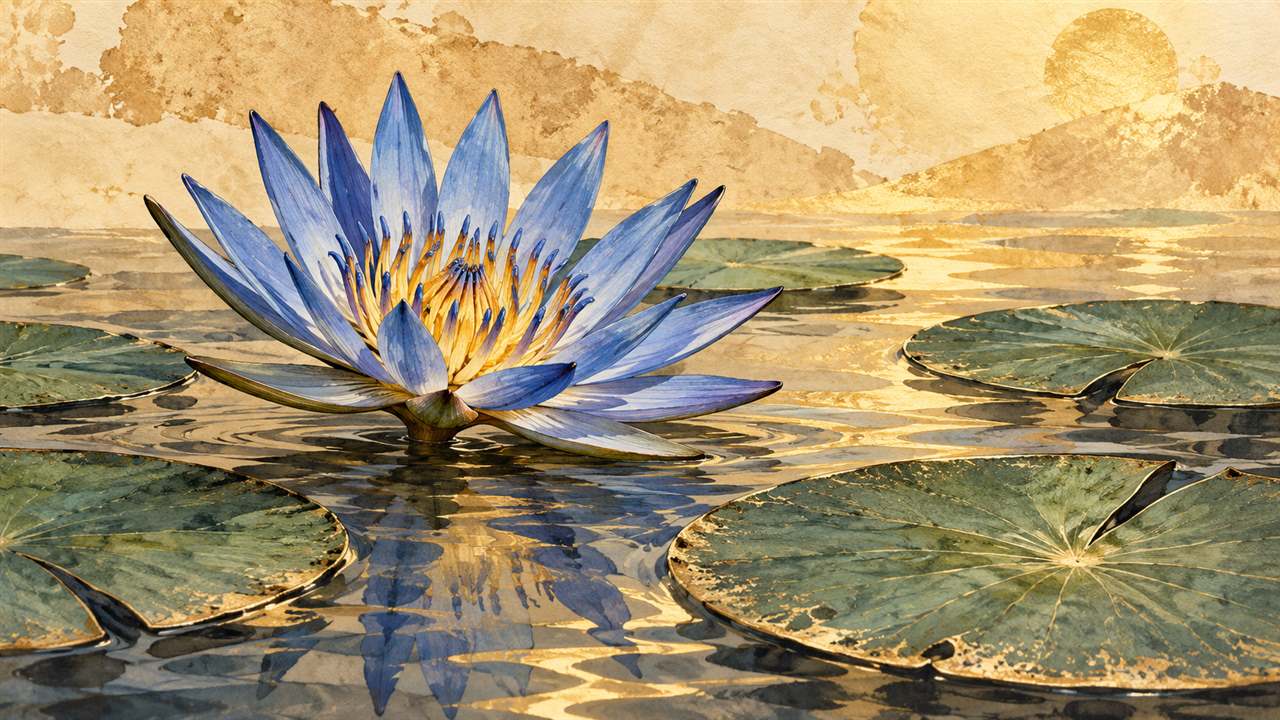
The flower in ancient Egyptian art is a different plant. The Metropolitan Museum of Art’s Model Lotus Flower object record explains that what is called the Egyptian lotus is in fact a water lily. Water lilies tend to rest their flowers and leaves closer to the water’s surface, and they belong to a separate plant family from the sacred lotus.
Why the difference matters
It might sound like botanical fussiness, but it changes how you read the image. If you assume every water flower in ancient art is the Buddhist lotus, you might bring ideas about enlightenment to an Egyptian object that was saying something quite different. Knowing which plant is in front of you is the first step toward knowing what it meant to the people who made it. When a museum label says “lotus,” it is worth checking whether the description mentions a water lily, especially for Egyptian pieces.
The lotus in Buddhist symbolism
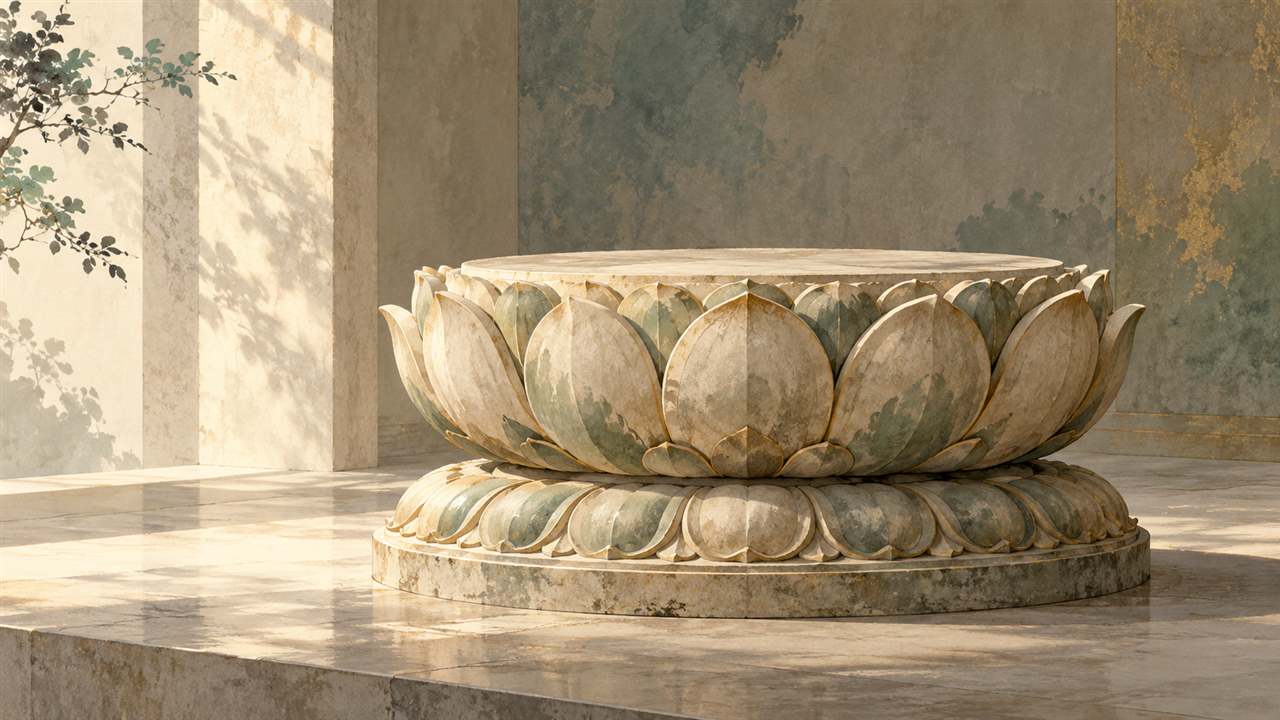
In Buddhist art and teaching, the lotus is one of the most familiar images there is. The Rubin Museum’s essay on the lotus as a sacred symbol associates it with purity, awakening, transformation and compassion. It also notes how often Buddhist figures are shown seated or standing on lotus thrones, or holding a lotus in their hands.
The Art Institute of Chicago’s glossary entry on the lotus points to the core Buddhist metaphor: a flower that grows from mud yet blooms unstained. Read that way, the mud is not something to be ashamed of. It is the ground the flower needs. The image suggests that awakening grows out of ordinary, messy life rather than requiring escape from it.
When you see a figure on a lotus base, the flower usually signals that the figure belongs to a realm of purity and awakening. The details beyond that, including which figure it is, what the hands are doing and what other objects appear, depend on the specific school, region and artwork. That is where a good museum label or a knowledgeable guide becomes valuable.
The lotus in Hindu symbolism
The sacred lotus is also deeply woven into Hindu imagery. The Rubin Museum notes that Hindu as well as Buddhist deities are commonly depicted on lotus thrones or holding the flower, and the University of Vermont overview ties Nelumbo nucifera to Hindu symbolism as well as Buddhist.
Because Hinduism is vast and varied, with many deities, regional practices and textual traditions, it is wise to avoid boiling the Hindu lotus down to a single slogan. In general terms, the flower appears as a seat or attribute of divine figures and carries associations of purity and spiritual flourishing, similar in spirit to Buddhist usage. Beyond that, the meaning in a particular temple, painting or ritual is best learned from that context and from people who practice within the tradition.
Buddhism and Hinduism share some imagery because they developed in overlapping parts of the world, but they are distinct religions with their own teachings. A lotus in a Hindu painting is not simply a Buddhist lotus with a different figure on top.
The lotus in ancient Egyptian symbolism
Ancient Egypt offers a quite different story. The Met’s object record explains that the Egyptian “lotus,” the water lily, was associated with daily rebirth and the renewal of the sun. You can see the logic in the plant itself: the flower closes and opens with the daily rhythm of light, as if repeating a small sunrise each morning.
That makes the Egyptian flower less about rising pure from mud and more about cycles: daily return, renewal, the dependable reappearance of light. When you meet a water lily on an Egyptian object, thinking about the sun and the daily cycle will usually get you closer to its meaning than thinking about enlightenment.
This guide does not try to date the symbol or trace its full history. If you want to go deeper, the Met’s collection records are a good place to start, because each object description is tied to a specific piece.
The lotus in Daoist and wider East Asian art
The lotus also travels beyond Buddhism. The Art Institute of Chicago’s glossary notes that it appears in Daoist images too. As ideas and artistic styles moved across East Asia, the flower picked up local meanings and sat alongside other symbolic systems, such as the paired forces described in our guide to yin and yang. If you see a lotus in a Chinese, Korean, Japanese or Vietnamese artwork, it may be Buddhist, Daoist, decorative or a blend. Context, again, is what tells you.
Comparing the traditions
| Tradition | Plant usually meant | Common associations | Where you often see it |
|---|---|---|---|
| Buddhist | Sacred lotus (Nelumbo nucifera) | Purity, awakening, transformation, compassion | Lotus thrones, flowers held by figures |
| Hindu | Sacred lotus (Nelumbo nucifera) | Purity and spiritual flourishing, linked with deities | Lotus seats, flowers held by deities |
| Ancient Egyptian | Water lily | Daily rebirth, solar renewal | Objects and decoration in museum collections |
| Daoist and wider East Asian art | Usually the sacred lotus | Varies with context and tradition | Paintings, ceramics, decorative arts |
Treat the table as a starting map. Every individual artwork can add, shift or complicate these patterns.
How to read a lotus in an artwork
You don’t need to be an art historian to get more out of a lotus image. The steps below are our own suggestions for looking closely.
1. Identify the plant
Are the flowers held high above the water on tall stems, with large round leaves? That points toward the sacred lotus. Are they resting low on the water’s surface, perhaps with pointed petals? That may be a water lily. Stylized art can blur the difference, so use this as a clue, not a verdict.
2. Notice where the flower sits
A lotus under a seated figure works differently from one held in a hand, one growing in a pond scene, or one repeated as a border pattern. A throne usually signals status or sacredness. A border may be mainly decorative.
3. Look at what surrounds it
Who or what is with the lotus? Other objects, gestures, animals and inscriptions all help narrow down the tradition and the message. A single motif rarely carries the whole meaning alone.
4. Read the label, then look again
Museum labels and collection records tell you where and when a piece was made and what tradition it belongs to. After reading, go back to the object and see what you notice now.
Two illustrative museum visits
These are imagined scenarios to show the method, not descriptions of specific objects.
Imagine standing in front of a small bronze figure seated on a base of upturned petals. The label tells you it comes from a Buddhist context. Knowing that the lotus seat often signals purity and awakening, you start to see the figure as raised above ordinary circumstances. Then you notice the hand gestures and the objects around it, which the label explains further.
Now imagine moving into an Egyptian gallery and finding a painted vessel decorated with blue flowers. Your first instinct might be “lotus, enlightenment.” The label says water lily. Remembering the link with daily rebirth and the sun, you look at the design again and start to read it as a picture of renewal, not of awakening.
Common misunderstandings
“The lotus means the same thing everywhere”
It doesn’t. There are shared themes, but Buddhist, Hindu, Egyptian and Daoist uses each have their own emphasis. Flattening them into one “Asian” or “ancient” meaning loses what makes each tradition distinct.
“Each color has a fixed meaning”
You will find charts online assigning a precise meaning to white, pink, red, blue and purple lotuses. Some traditions and modern writers do give certain colors particular associations, but those associations vary by source, school and region. There is no single color chart that holds across Buddhism, Hinduism and ancient Egypt, so any color interpretation needs a source tied to its particular tradition.
“Every water flower is a lotus”
As the Egyptian example shows, the sacred lotus and the water lily are different plants with different symbolic histories. Getting the plant right is the start of getting the meaning right.
“A lotus will bring luck”
The lotus is a symbol with deep religious and cultural meaning. Its symbolic associations do not guarantee prosperity, health or good fortune. Understanding the religious or cultural setting gives the image more depth.
Choosing lotus artwork or jewelry thoughtfully
Lotus imagery is everywhere, from fine art prints to pendants and tattoos. A few questions can help you choose with care.
Is it decorative or devotional? A stylized lotus pattern on a cushion is different from a statue of a deity on a lotus throne. Sacred images often carry expectations about placement and treatment. If you are drawn to a religious piece, it is worth learning how people in that tradition treat it.
Which tradition is it drawing on? Ask the seller, or read the description closely. A piece described as “Egyptian lotus” may actually show a water lily, which tells you more about its intended meaning.
Where will it live? If you plan to place lotus imagery on a family altar or memorial shelf, family customs come first. Our guide to ancestor worship and Vietnamese traditions explains why it helps to ask before assuming.
Do you know what it means to you? It is fine to love a lotus simply because it is beautiful. Being honest about that, rather than borrowing a sacred meaning you don’t hold, is a form of respect.
Personal reflection prompts
These prompts are a modern, personal way of engaging with the image. They are not religious practice and are not drawn from any tradition’s teaching.
What “mud” in your own life has turned out to feed something good?
Where are you trying to stay clear and steady while things around you are messy?
What renews itself in your days, the way the water lily opens again each morning?
Which part of the lotus image speaks to you most: the roots, the stem, the open flower? Why?
Frequently asked questions
What does the lotus flower symbolize?
In Buddhist and Hindu traditions it is widely associated with purity, spiritual awakening and transformation, drawing on how the flower rises clean from muddy water. In ancient Egypt, the water lily called “lotus” was linked with daily rebirth and the sun.
What did the lotus flower mean in ancient Egypt?
The Egyptian “lotus” was a water lily, and it was associated with daily rebirth and the renewal of the sun, reflecting how the flower opens and closes with the light.
Is the Egyptian lotus the same as the Buddhist lotus?
No. The Buddhist and Hindu lotus is the sacred lotus, Nelumbo nucifera. The Egyptian flower was a water lily, a different plant with a different symbolic history.
Why do Buddhist and Hindu figures sit on lotus flowers?
The lotus throne generally signals purity and a sacred or awakened status. Specific meanings depend on the figure, tradition and artwork.
Do lotus colors have specific meanings?
Some sources assign meanings to particular colors, but these vary between traditions and writers. There is no single, universal lotus color chart.
Is it respectful to wear lotus jewelry or display lotus art?
Generally, yes, especially for decorative designs. For clearly religious images, learn how the tradition treats them and choose placement thoughtfully.
Sources and further reading
Rubin Museum of Himalayan Art, “The Lotus Flower: Sacred Symbol of Transcendence”.
Art Institute of Chicago, Taoism and the Arts of China glossary: Lotus.
The Metropolitan Museum of Art, collection object record.
University of Vermont, Department of Plant Biology, “Symbolism and Plants”.